How to play Mahjong Solitaire
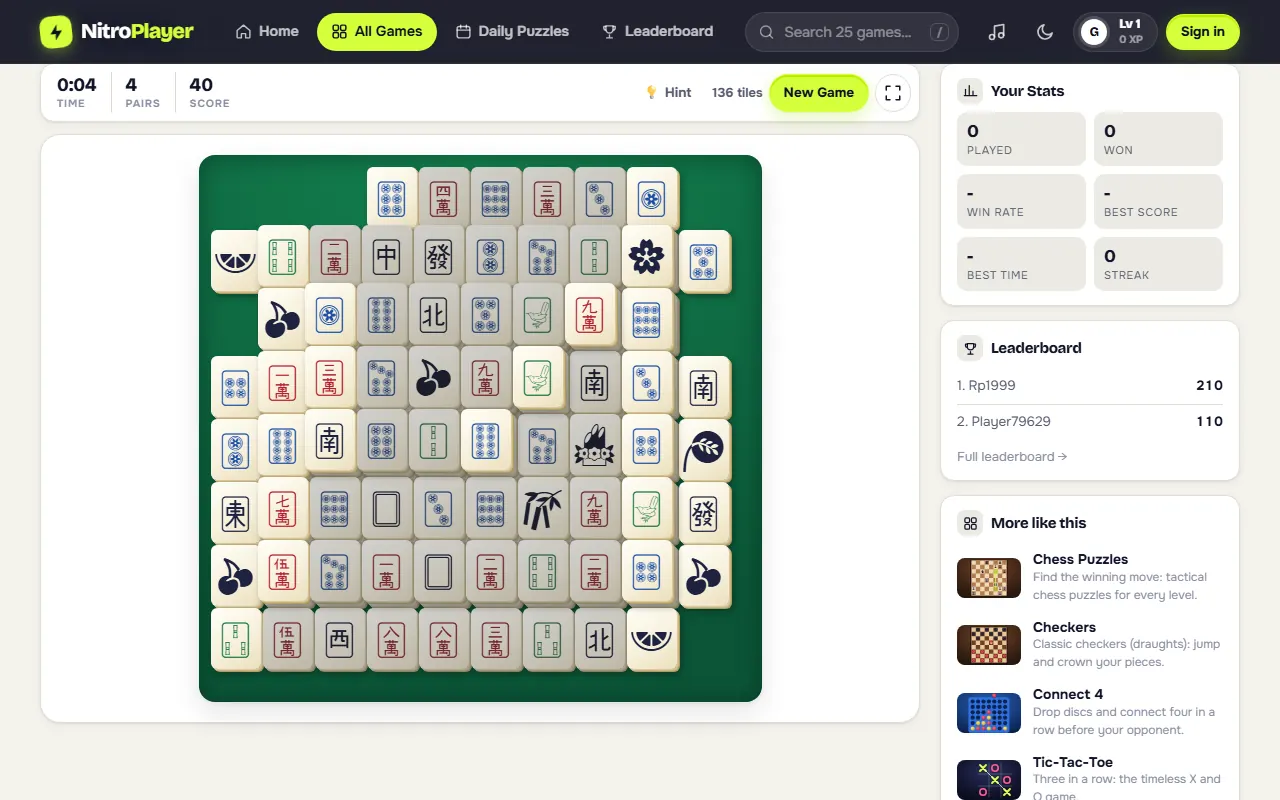
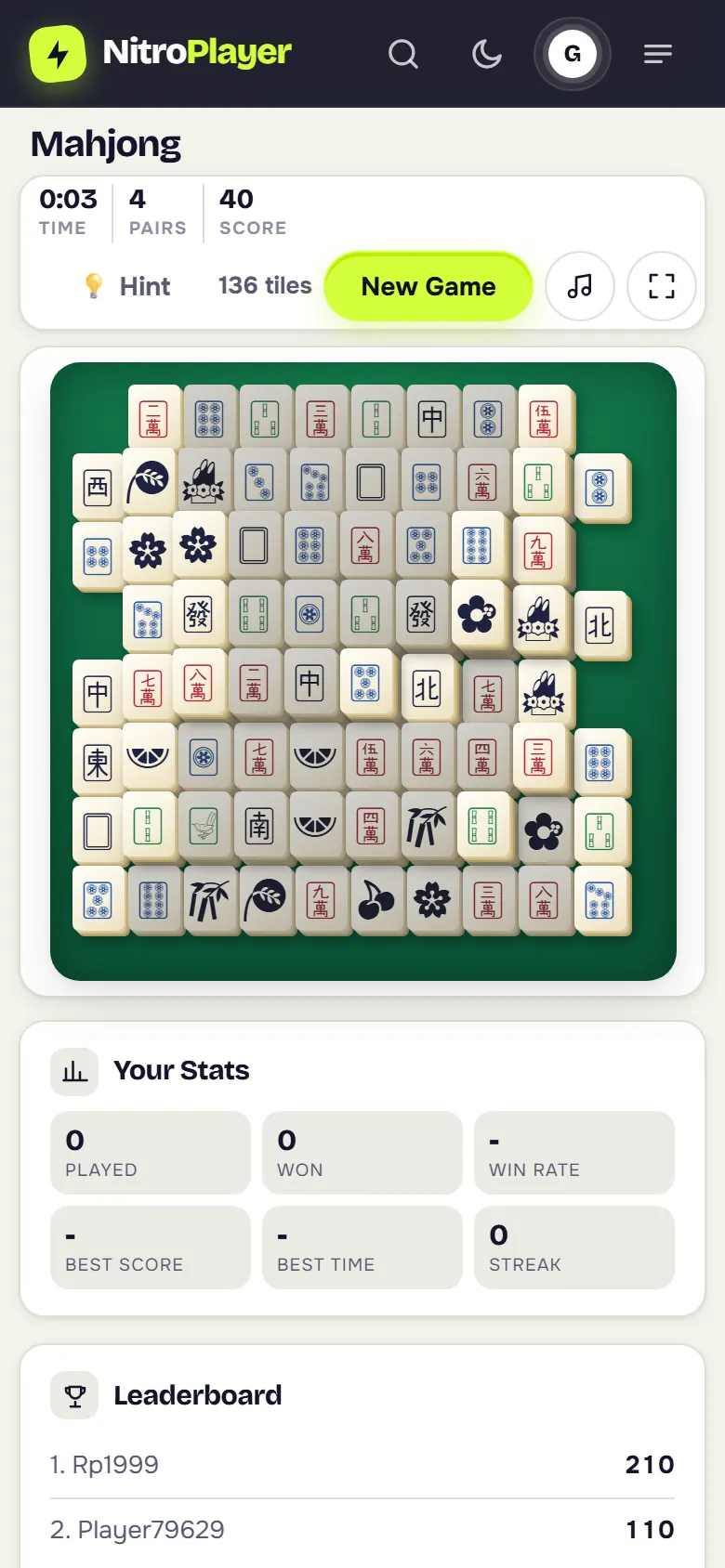
The tiles are stacked in the classic turtle layout: a wide base of 87 tiles, smaller layers of 36, 16 and 4 on top of it, and a single tile crowning the peak, with lone tiles sticking out at both ends like a head and a tail. Most designs appear exactly four times, so each one can be cleared as two pairs.
- Find a free tile. Free tiles are drawn brighter than blocked ones, so you can spot them at a glance.
- Select it. Click or tap the tile. Tap it again to cancel.
- Pick its twin. Select another free tile with exactly the same design. The pair disappears and you score 10 points.
- Keep going. Removing tiles frees the ones underneath and beside them. Clear all 144 tiles to win.
If the second tile does not match, the selection simply moves to it. There is no penalty for a wrong pick. Three buttons help along the way: Hint shows a free pair, Undo takes back your last pair, and Shuffle re-deals the tiles still on the board when no free pair is left.
What makes a tile free?
This is the one rule that decides every board. A tile is free when both of these are true:
- Nothing is on top of it. A tile covered by a tile on a higher layer cannot be selected.
- Its left or right side is open. A tile squeezed between neighbors on both sides of the same row is blocked, even if nothing covers it.
Tiles above and below in the same layer do not matter; only left and right count. That is why the ends of each row are always the first places to look.
The mahjong tiles in this set
This is the full traditional set of 144 tiles: 34 designs with four copies each, plus eight bonus tiles.
| Group | Tiles | How they match |
|---|---|---|
| Characters | 1 to 9, four of each | Identical tile only |
| Circles (dots) | 1 to 9, four of each | Identical tile only |
| Bamboo | 1 to 9, four of each | Identical tile only |
| Winds | East, South, West, North, four of each | Identical tile only |
| Dragons | Red, Green, White, four of each | Identical tile only |
| Flowers | Plum, Orchid, Bamboo, Chrysanthemum, one of each | Any flower matches any flower |
| Seasons | Spring, Summer, Autumn, Winter, one of each | Any season matches any season |
Suit tiles, winds and dragons only pair with an identical design. Look closely at the numbered suits: a 3 Circle and a 4 Circle look alike at a glance but will not pair. The bonus tiles are the exception, just as in the traditional rules: a Plum can go with an Orchid, and Spring can go with Winter.
Scoring and leaderboard
Each pair is worth 10 points, so a cleared board scores 720. The toolbar shows your score, the pairs removed, the tiles left and a running timer. Since every finished board earns the same points, speed is what separates strong players. Cleared boards count toward your stats and the Mahjong leaderboard.
Strategy for clearing the board
- Open the middle early. The center is the tallest part of the pile, and the tiles hidden under it are the hardest to reach.
- Work long rows from the ends. A long row is reachable only at its two ends, so each end tile you remove opens the next one.
- Look before you match. When several free copies of a design are visible, ask which pair unlocks the most new tiles.
- Four free copies are a gift. If all four copies of a design are free at once, clear them in any order without risk.
- Choose carefully with three. When three copies are free, leave the third one in the spot where it blocks the least.
- Never bury a match. If the last two copies of a design sit one on top of the other, the bottom one can never be freed.
- Save easy edge pairs. Tiles at the outer edges are often free from the start and will still be there later, so keep them as spare moves.
- Use Hint, Undo and Shuffle wisely. Hint highlights a matching free pair. Undo takes back a pair you regret. If no free pair is left, Shuffle re-deals the remaining tiles into a position that can still be solved. You get 3 shuffles per game, and once they are used up with no pair left, the board is lost.
Daily Mahjong
Every day there is a new Daily Mahjong board with the same layout for every player. Open it from the daily puzzles page and clear it as fast as you can, because the daily ranking is by time. Coming back each day keeps your streak going.
Mahjong duels: same layout, eight minutes
A duel turns the calm puzzle into a race. Choose Play online to meet whoever is available, or Play with a friend to share a private link.
- Both players get the same layout and play on their own boards.
- Live progress shows how many pairs each side has removed.
- The first to clear every tile wins. After 8 minutes, the player with more pairs removed wins.
- Hint and Undo are off, so you have to trust your own eyes. Shuffle still works if you get stuck.
Mahjong Solitaire vs. classic Mahjong
Classic Mahjong is a four-player game that took shape in China in the 19th century. Players draw and discard tiles to build sets, a little like the card game rummy. Mahjong Solitaire borrows the same tiles but turns them into a one-player matching puzzle.
The solitaire version appeared on computers in the early 1980s. Brodie Lockard created an early version on the PLATO system in 1981, and Activision's Shanghai in 1986 brought tile matching to a wide audience.
Mahjong on a phone or tablet
The tiles size themselves to the width and height of your screen, so the whole layout fits without pinching or zooming. On a small phone the tiles get compact, and the bright free tiles help you aim. Install NitroPlayer to start a board straight from your home screen. Your board is saved automatically, so you can close the page and continue later.
Enjoy matching? Train your recall with Memory Match, a pairs game where the cards are face down.