How to play Spider Solitaire
Spider uses 104 cards, the size of two standard decks, in every mode. With 1 suit every card is a spade, with 2 suits the deck is spades and hearts, and with 4 suits all four suits appear.
The setup
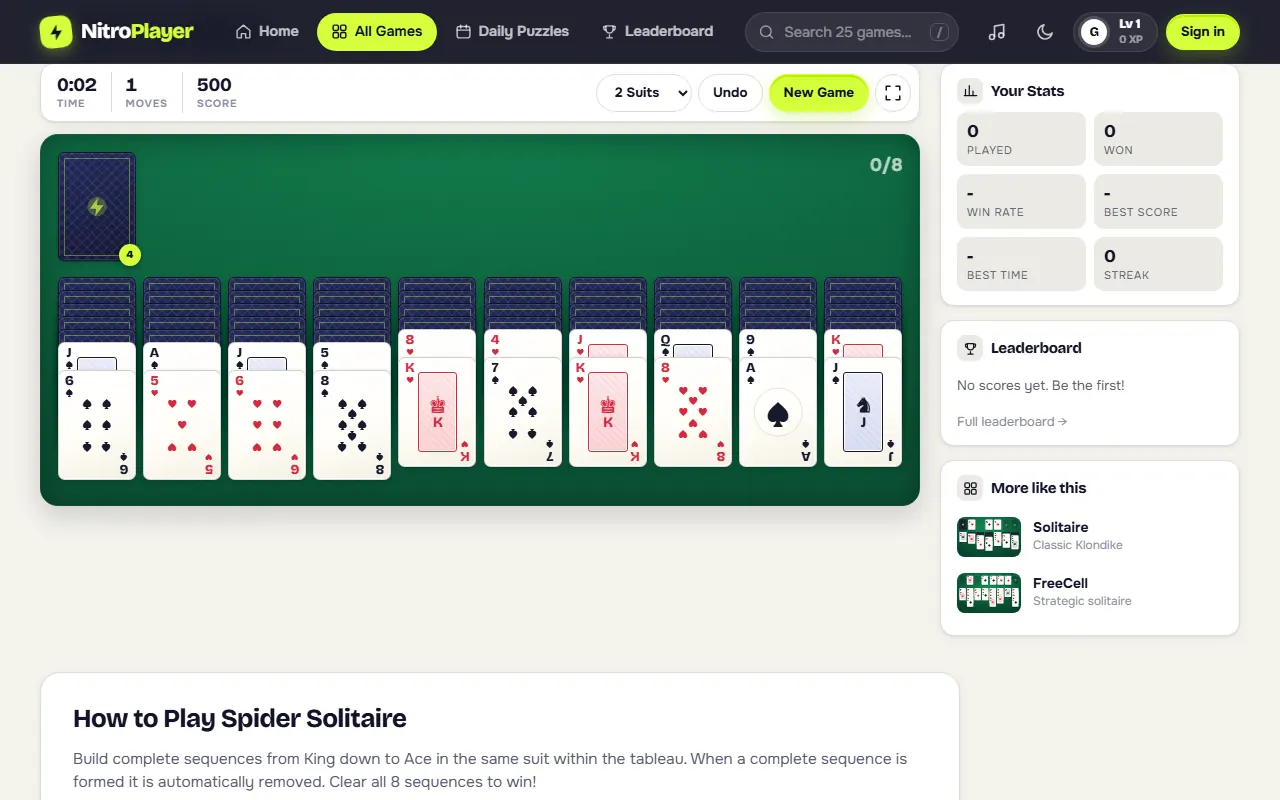
- 54 cards are dealt into ten columns: the first four get six cards, the other six get five.
- Only the top card of each column is face up.
- The other 50 cards form the stock, enough for five more deals of ten cards.
- A counter shows how many of the eight runs you have completed.
Step by step
- Move a face-up card onto a card exactly one rank higher, in any suit (a 7 of hearts can go on an 8 of spades).
- A group of cards can only move together if it is a descending run of one suit.
- When you uncover a face-down card, it turns face up.
- Any card or same-suit run can go into an empty column.
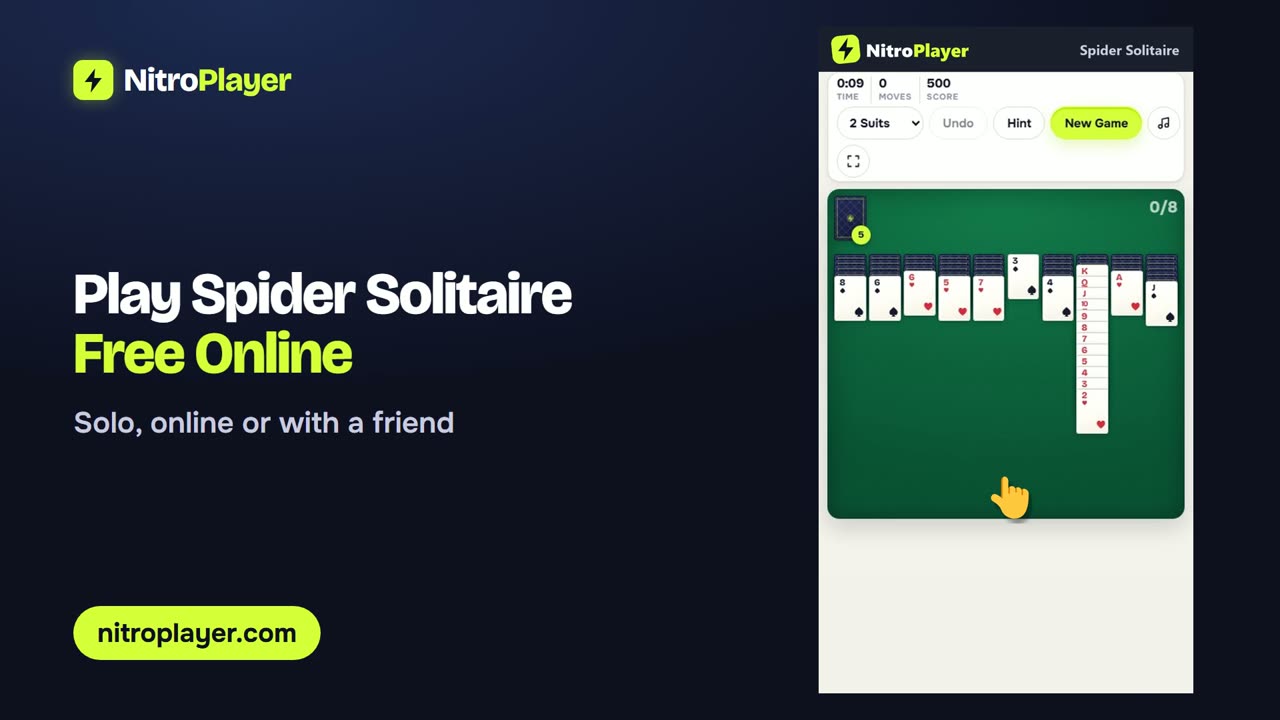
- Not sure what to do next? Press Hint: the best movable run and its target glow, with same-suit builds and moves that turn over a hidden card shown first. If no useful move is left, Hint points to the stock.
- When you are stuck, click the stock to deal one new card onto every column. Every column needs at least one card before you can deal.
- A full same-suit run from King to Ace is removed from play automatically.
- Clear all eight runs to win.
Choosing 1, 2 or 4 suits
The rules never change, but the number of suits changes everything:
| Level | Suits in the deck | What it feels like |
|---|---|---|
| 1 suit | Spades only | Every downward build is also a movable run. Relaxed, and most deals can be won. |
| 2 suits | Spades and hearts | You must choose between building anywhere and keeping runs pure. A good middle ground. |
| 4 suits | All four | Mixed builds block you fast. Empty columns and careful planning decide the deal. |
Switching levels starts a new deal, and the game remembers your choice for next time. Hint and Undo work at every level in solo play.
Scoring
- Every game starts at 500 points.
- Each move between columns costs 1 point, so efficient play scores higher.
- Each completed King to Ace run earns 100 points.
- Turning over a face-down card earns 5 points.
Your results are recorded on your profile, and high scores appear on the leaderboard.
Strategy for two and four suits
- Treat empty columns as gold. An empty column lets you take runs apart and rebuild them. Avoid filling it with a lone card unless that opens something up.
- Build in suit whenever you can. A 6 of hearts on a 7 of hearts can move later as part of a run; the same 6 on a 7 of spades is stuck until you break it apart.
- Turn over hidden cards early. Face-down cards are what make deals unwinnable. Favor moves that reveal one.
- Attack the shortest columns. A column with only one or two hidden cards can be emptied quickly.
- Delay the next deal. A deal drops a card on every column and can bury good runs. Make every useful move first.
- Tidy up before you deal. Leave your best runs on top, because each column is about to get a random card.
- Plan for Kings. A King can only move to an empty column, so think ahead before you uncover one.
- Pace the stock. There are five deals in total. Keep some flexibility for the late game.
Spider duels: one suit, eight minutes
In a duel, Spider becomes a race on identical cards. Choose Play online to face whoever is available, or Play with a friend to send a private link.
- Duels are always played with one suit, on the same deal for both players.
- Progress counts cards cleared in completed runs, shown live for both sides.
- The first to clear all eight runs wins. If nobody finishes in 8 minutes, the player who cleared more cards wins.
- Hint and Undo are off and the suit selector is locked until the duel ends.
When it is over, ask for a rematch on a fresh deal.
Where Spider comes from
Spider is a two-deck patience game, and its name is usually linked to the eight runs you complete, like the eight legs of a spider. It was known to patience players long before computers, but it reached a much larger audience when Microsoft added Spider Solitaire to Windows, first in the Plus! 98 pack and then in Windows Me and Windows XP. The 1, 2 and 4 suit levels made it easy to start and hard to master.
Spider on a phone
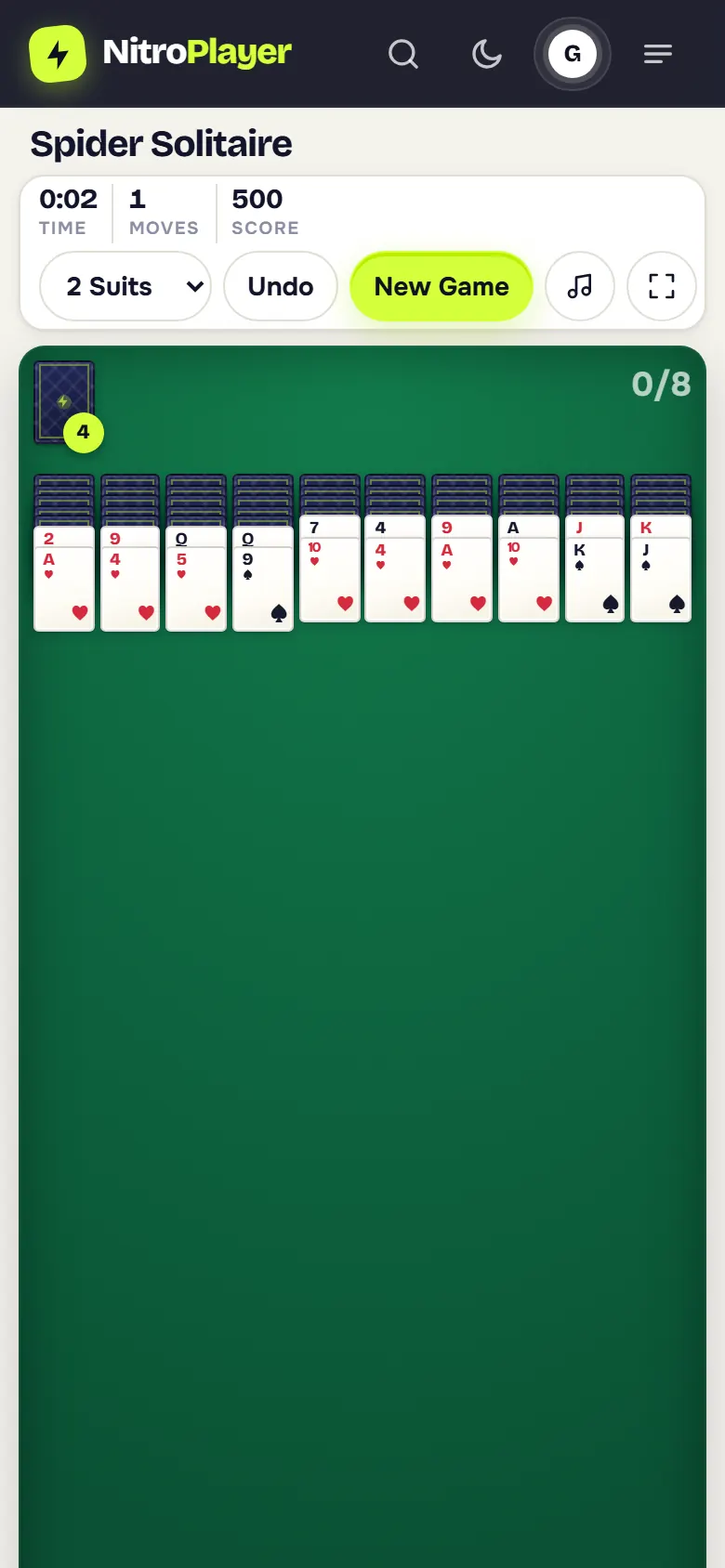
Ten columns are a lot for a narrow screen, so turn your phone sideways: the cards grow and long runs stay readable, because the columns squeeze their overlap to fit the screen height. Tap a card to pick up the run beneath it, then tap the column where it should go. Installing NitroPlayer on your home screen gives you a full-screen table without the browser bar. The deal is saved as you play, so a call or a closed tab costs you nothing.
Want something quicker between deals? Pyramid Solitaire takes only a few minutes, and classic Klondike is one tap away.