How chess puzzles work here
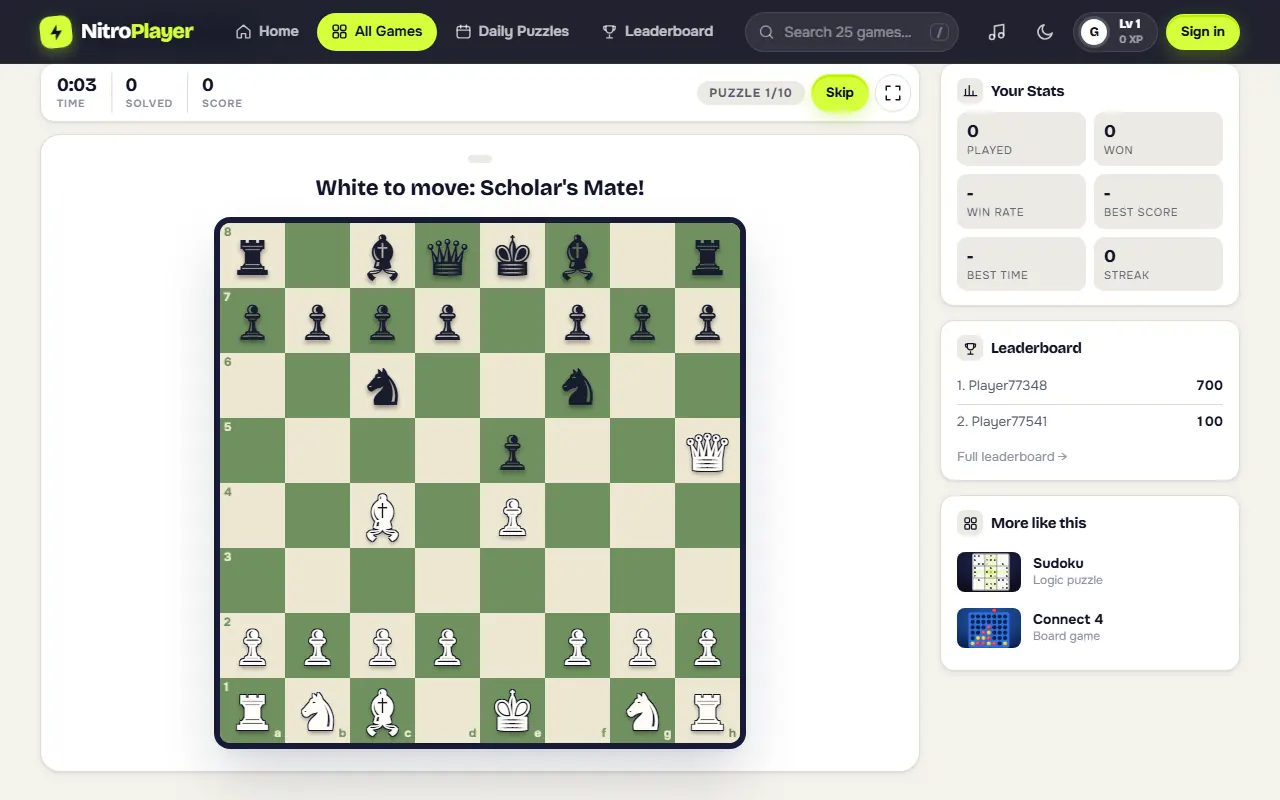
- Watch the setup move. Every puzzle starts from a real game position. The opponent's last move is played for you, and the board turns so your side is at the bottom.
- Find the best move. Tap or click a piece to see its legal squares, then tap the destination. Castling, en passant and promotion all work, and you choose the piece when a pawn promotes.
- Keep going. Many puzzles need two, three or more moves. After each correct move the opponent replies, and you continue until the tactic is finished.
- Checkmate always counts. If your move delivers mate, it is accepted even when it is not the move stored in the solution.
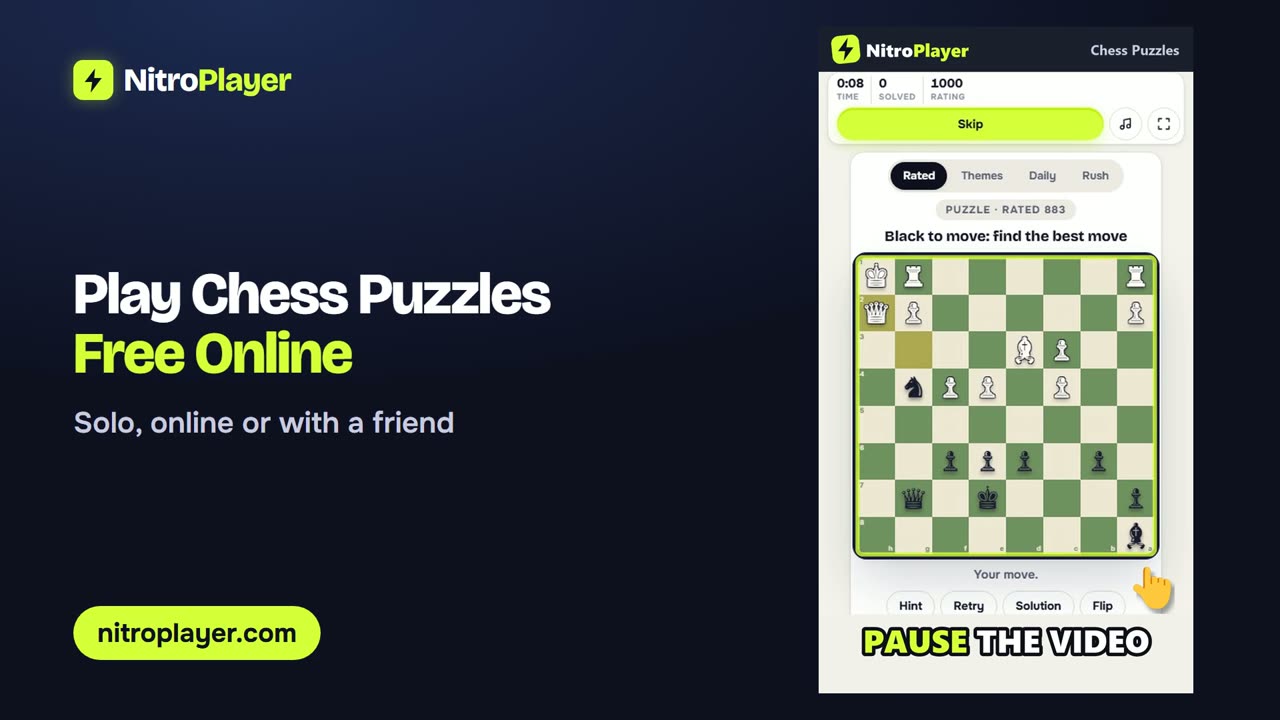
- Use the tools. Hint highlights the piece to move, a second hint shows its square, Retry starts the puzzle over, Solution plays the answer out, and Flip turns the board. The move list under the board shows the whole sequence in chess notation.
Four modes: Rated, Themes, Daily and Puzzle Rush
| Mode | What you get | Best for |
|---|---|---|
| Rated | Puzzles picked close to your puzzle rating, which starts at 1000 and moves after every puzzle | Steady practice and measuring progress |
| Themes | Rated puzzles from one motif: mate in 1, mate in 2, mate in 3+, fork, pin, skewer, discovered attack, sacrifice, mixed tactics or endgame | Drilling a pattern until it is automatic |
| Daily | One daily chess puzzle, the same for everyone on that date | A quick habit with your morning coffee |
| Puzzle Rush | As many puzzles as you can in 3 minutes, starting easy and getting harder, three wrong moves and you are out | Speed and pattern recognition |
Your mode and theme are remembered, and recently played puzzles are kept out of rotation, so you rarely see the same position twice in a session.
Your puzzle rating
Every puzzle has its own rating, from about 650 for simple one-movers to over 2,600 for deep combinations, split into five bands:
- Under 1000: beginner tactics and one-move mates.
- 1000 to 1399: club basics such as forks, pins and short mates.
- 1400 to 1799: two- and three-move combinations.
- 1800 to 2199: quiet moves, deflections and longer lines.
- 2200 and up: expert puzzles that take real calculation.
Solve a puzzle on the first try and your rating goes up; miss it and it goes down, by more when the puzzle was rated below you. The rating moves quickly over your first puzzles (a question mark shows it is still settling) and then becomes steadier, similar to the Glicko system used by many chess sites. A puzzle where you made a wrong move, used a hint or opened the solution counts as missed, so solving it afterwards is practice only. Your rating is saved to your profile, and the chess puzzles leaderboard has a Top rating board that ranks players by their current puzzle rating once they have solved a few rated puzzles.
Mate in 2 puzzles and other themes
Switch to Themes and pick a motif from the menu. Each one trains a pattern you will meet in your own games:
- Mate in 1, 2 and 3+: forced checkmates. Mate in 2 puzzles are the classic way to learn how a quiet first move can take away the king's last escape square.
- Fork: one piece attacks two targets at once, often a knight hitting king and queen.
- Pin and skewer: a line piece attacks through one piece to another behind it.
- Discovered attack: moving one piece unmasks an attack by another.
- Sacrifice: give up material for a bigger gain a few moves later.
- Endgame: technique with few pieces left, where every tempo matters.
Puzzle Rush and chess puzzle duels
Puzzle Rush gives you 3 minutes on the clock. The first puzzles are easy and each one is a little harder than the last. A wrong move costs one of three strikes and moves you to the next puzzle, and there are no hints or retries. Your best run is kept, so there is always a score to beat, and it has its own Puzzle Rush board on the leaderboard, ranked by the most puzzles solved in a single run.
In a chess puzzle duel, two players get the same 20 puzzles in the same order and 3 minutes. The player who solves the most wins, and a tie goes to whoever made fewer mistakes. A wrong move skips that puzzle and locks your board for 5 seconds, so guessing is expensive. Play online with whoever is available, or send a private link to a friend and settle who calculates faster.
How to get better with a chess tactics trainer
- Look at checks, captures and threats first. Most puzzle solutions start with one of the three. List them before you touch a piece.
- Calculate to the end. In a three-move puzzle, picture the opponent's best reply to your first move before you play it.
- Ask what the last move changed. The setup move often leaves a square, a line or a piece undefended.
- Short daily sessions beat rare marathons. Twenty rated puzzles a day tend to build pattern memory better than one long weekend session.
- Train weak themes on purpose. If skewers keep catching you out, spend a session on the Skewer theme.
- Use Rush for speed, Rated for depth. Rush trains instant recognition; rated puzzles near your level train careful calculation.
Chess puzzles on your phone
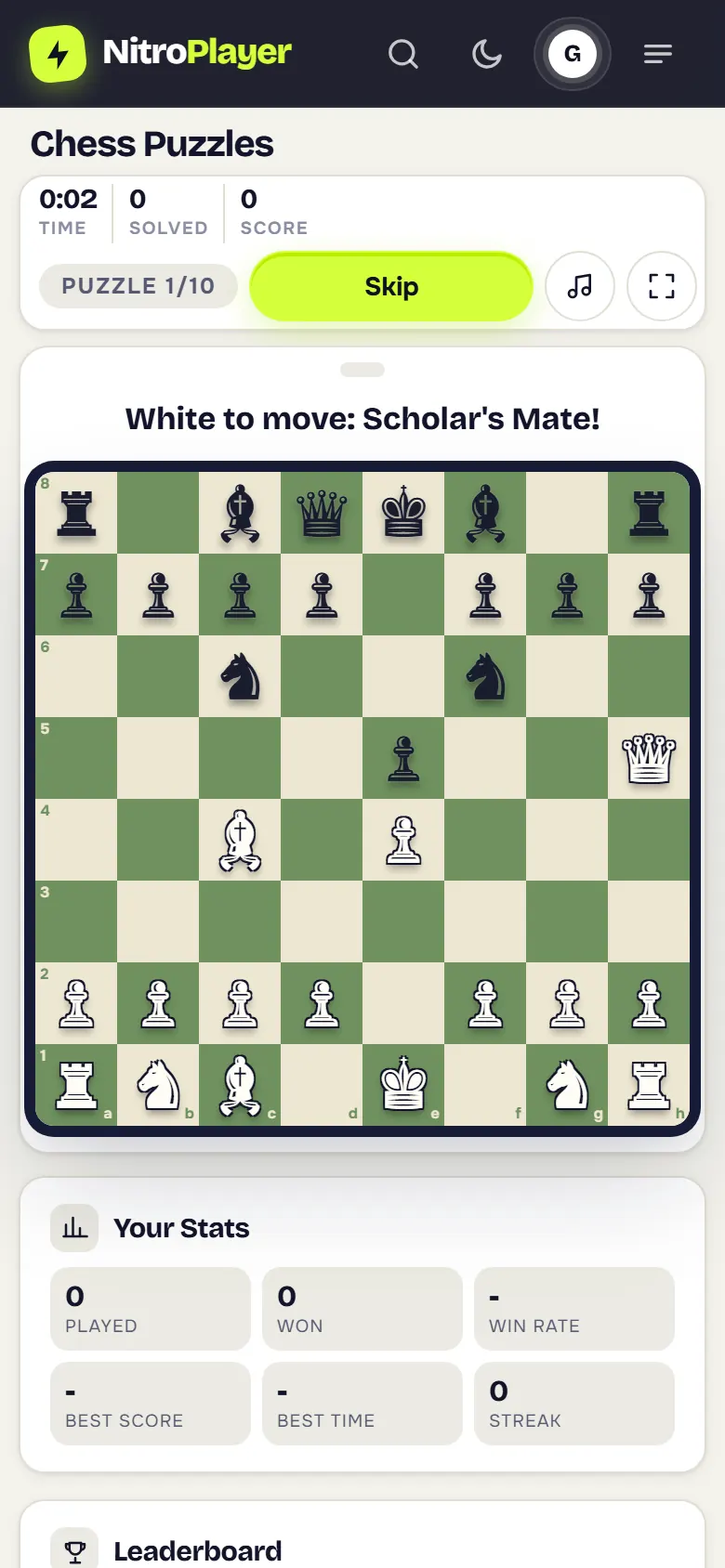
The board fits a phone screen in portrait, and moves are two taps: the piece, then one of the marked squares. Promotions open a small picker with queen, rook, bishop and knight. Once you have made a move, the puzzle is saved, so if you close the tab you come back to the same position with the same rated status. To keep your daily puzzle one tap away, install NitroPlayer as an app.
Where the puzzles come from
All puzzles come from the Lichess puzzle database, which Lichess publishes under the CC0 public domain license. Each puzzle was taken from a real game and checked by computer analysis, and players rated it while solving. We selected 3,000 of them, 600 per rating band, plus a separate set for duels.
More strategy games
Want a full game instead of a single position? Play checkers against the computer on three levels, or try Reversi online. For another daily logic habit, solve Sudoku online.