How to play the falling blocks game
- Start with Enter, Space or a tap on the board.
- Move the falling piece with the Left and Right arrow keys.
- Rotate with the Up arrow. If a wall is in the way, the piece slides one cell sideways when that gives it room to turn.
- Drop. Down is a soft drop that speeds the piece up; Space is a hard drop that slams it to the bottom.
- Clear rows. Fill a row from wall to wall and it disappears, and everything above it falls one row.
- Avoid topping out. If a new piece has no room to appear, the game ends.
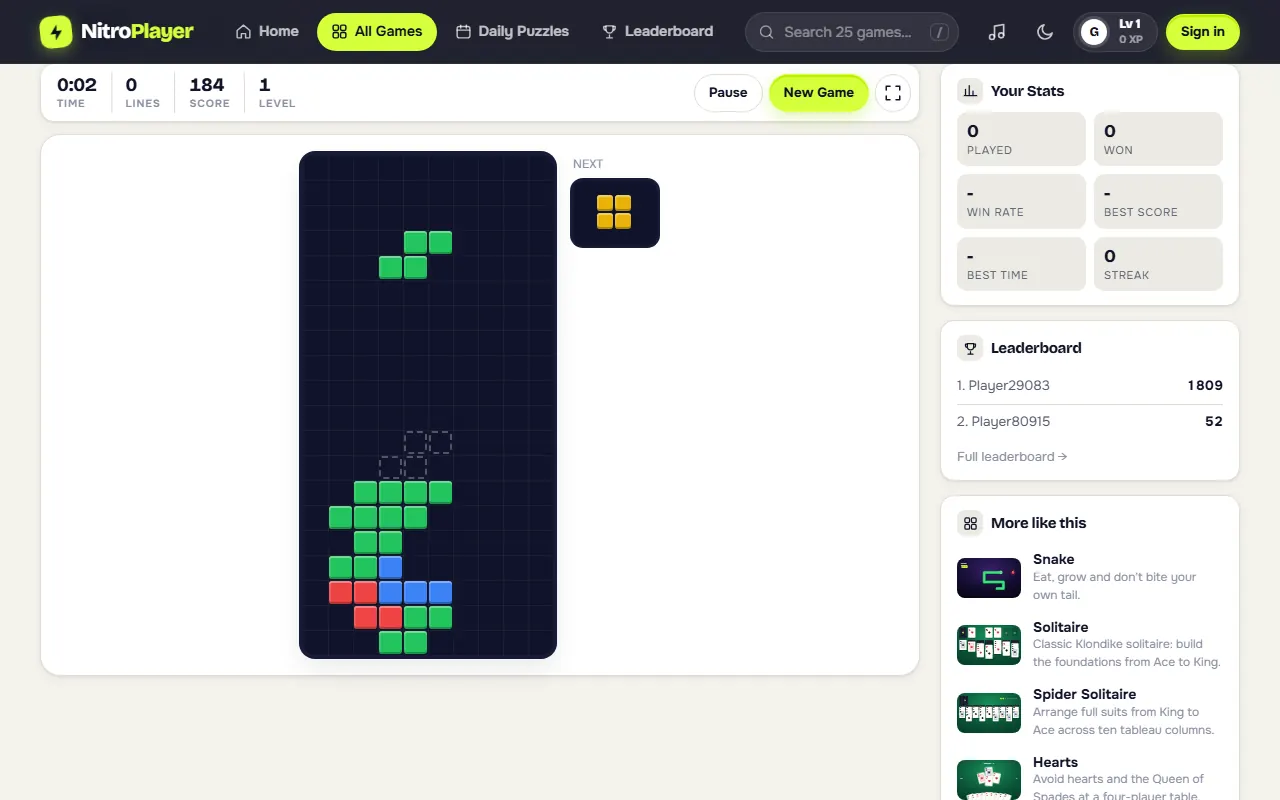
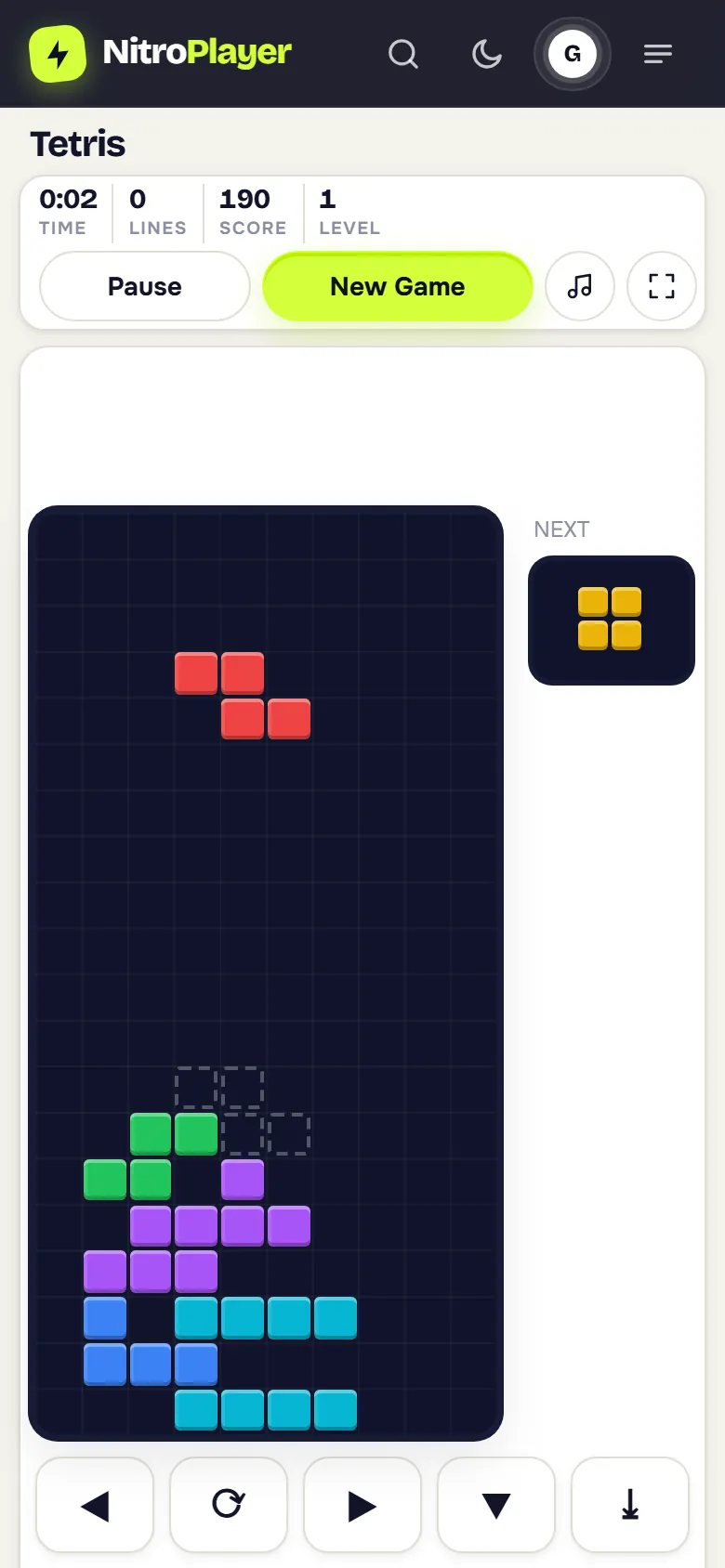
A faint ghost piece marks the landing spot and the Next box shows what is coming. P or Esc pauses a solo game, and it also pauses itself when you switch tabs or windows.
Levels and scoring
The well is 10 columns by 20 rows. Pieces are the seven classic four-square shapes, usually called I, O, T, S, Z, J and L, picked at random. You start on level 1 and go up a level for every 10 lines cleared, and each level shortens the drop interval.
| Rows cleared with one piece | Points | Garbage sent in battle |
|---|---|---|
| 1 | 100 x level | 0 |
| 2 | 300 x level | 1 row |
| 3 | 500 x level | 2 rows |
| 4 | 800 x level | 4 rows |
Hard drops add 2 points for every row the piece falls. Since line points scale with your level, the same four-row clear is worth eight times as much on level 8 as on level 1, which is why long runs climb the high score leaderboard so quickly.
Stacking strategy that lasts
- Keep the surface flat. A level stack accepts almost any piece. Towers and narrow pits are what end runs.
- Save one well for the I piece. Build the other nine columns up and keep an edge column open; one long piece then clears four rows.
- Prefer four-row clears when the stack is low. 800 x level beats four single clears by a wide margin.
- Never bury holes. A covered gap cannot be filled until every row above it is gone.
- Plan two pieces ahead. Decide where the Next piece fits before placing the current one.
- Lay S and Z flat on matching steps. Standing them up is the most common way to create holes.
- Hard drop once aligned. It earns points and brings the next piece sooner.
- Bail out with singles when you are high. Survival first; waiting for the perfect I piece near the top is a gamble.
2 player falling blocks battle
Battle mode is a live race for two. Play online with whoever is available, or send a private link so a friend joins your match.
- 3 minutes, same piece order. The sequence is seeded for the match, so neither player gets better shapes.
- Attack with clears. Doubles, triples and four-row clears send 1, 2 or 4 gray garbage rows, each with one hole, that rise from the bottom of your rival's well.
- Survive. If one player tops out, the other wins. If both top out, the one who lasted longer wins.
- Time up. When both are still alive after 3 minutes, the higher score takes it.
A mini board shows your opponent's stack during the race. Single clears send nothing, so in battle it pays to build for doubles and better instead of clearing every row the moment it fills. Pausing is disabled during a race.
Falling blocks on a touch screen
On a phone the board itself is the controller: drag sideways to move one cell per finger width, drag down to soft drop, tap to rotate and flick down fast for a hard drop. Hold the phone upright so the full 20-row well fits the screen. For a full-screen game that opens from your home screen, install the NitroPlayer app. A solo game is saved as you play and comes back paused after a refresh.
Where falling blocks puzzles come from
The genre began in 1984, when Soviet engineer Alexey Pajitnov built a puzzle around tetrominoes, shapes made of four squares, in Moscow. It spread worldwide in the late 1980s, and the 1989 handheld version made it a fixture of portable gaming. This game is an independent falling blocks puzzle and is not affiliated with or endorsed by the owners of the Tetris brand.
If you like quick reflexes, the classic Snake game has its own 2-minute race. For a slower brain workout, slide tiles in 2048.