How to play the Spades card game
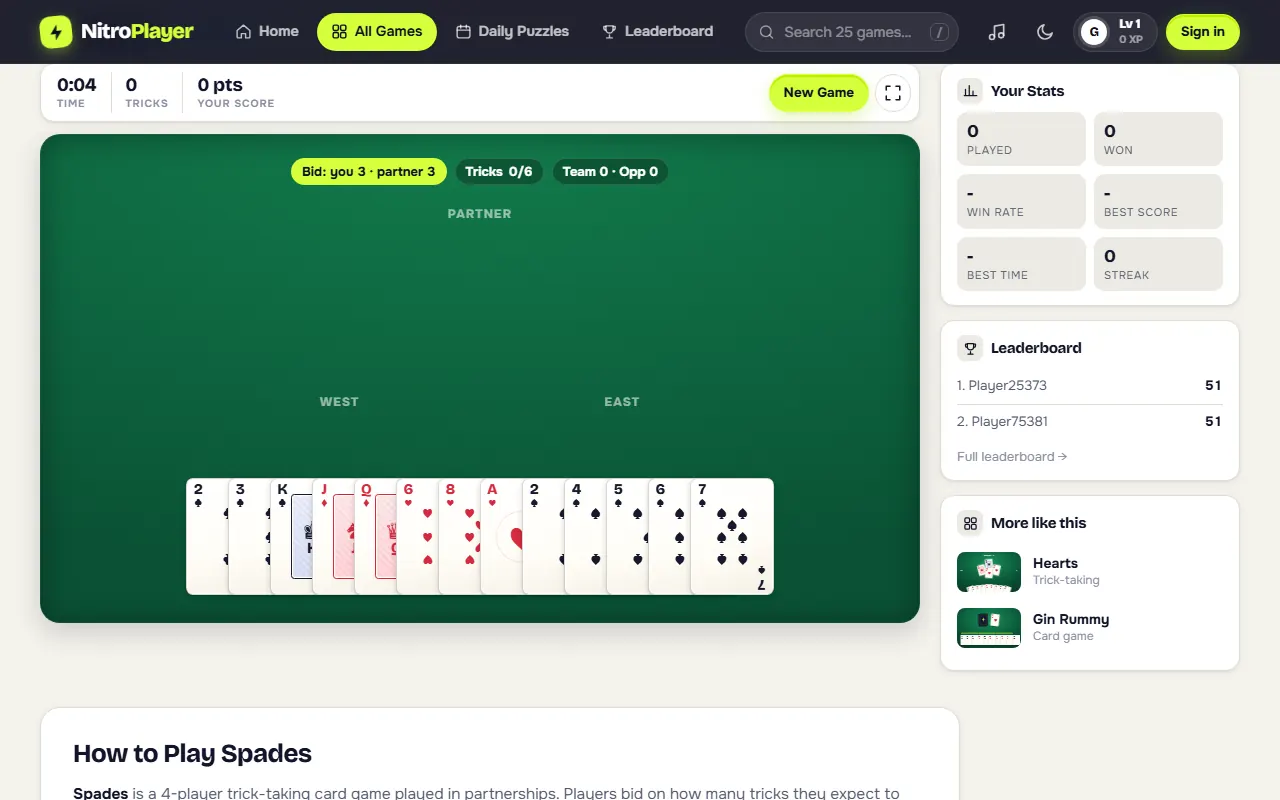
Four players form two teams, and partners sit opposite each other. On screen your partner is at the top, with the two opponents to your left and right. Every player gets 13 cards from a standard 52-card deck, and Aces are high.
- Bid. The deal passes one seat to the left every round, and bidding starts with the player left of the dealer. Choose how many tricks you expect to take, from 1 to 13, or bid Nil if you plan to take none. Your team's non-Nil bids add up to the team contract.
- Lead and follow. The player left of the dealer leads the first trick, and the others play in turn, clockwise. You must follow the suit that was led whenever you can.
- Trump with spades. When you cannot follow suit, you may play a spade or throw away any other card. The highest spade wins the trick; with no spade in it, the highest card of the led suit wins.
- Break spades. Nobody may lead a spade until a spade has been played on an earlier trick, unless they hold nothing but spades.
- Score the round. After 13 tricks, compare each team's tricks with its contract, add Nil bonuses or penalties, and carry the totals into the next round.
Spades bidding and scoring
Every round is scored with the standard contract math, and the scores carry over until the game ends:
| Result | Team score |
|---|---|
| Contract made (tricks at least equal to the bid) | 10 points per trick bid, plus 1 per extra trick (bag) |
| Contract missed (set) | Minus 10 points per trick bid |
| Nil made (the Nil bidder takes no trick) | Plus 100 |
| Nil failed | Minus 100 |
| Every 10 bags collected | Minus 100 |
Example: you bid 4 and your partner bids 3, so your contract is 7. Taking 8 tricks scores 71 and adds one bag. Taking 6 scores minus 70. A Nil bidder's tricks never count toward the partner's contract, but they do count as bags for the team.
Winning the game: the first team to reach 300 points wins. If both teams pass 300 in the same round, the higher score wins, and equal scores make the game a draw. A team that falls to minus 200 or lower ends the game and loses it. Finished games count toward the Spades leaderboard.
Spades strategy for better bids
Counting your tricks
- Start with sure winners. Count side-suit Aces and Kings plus your high spades, then add a little for length in spades.
- Long spades win late. Once the others run out of trump, every spade you still hold is likely to take a trick.
- Short side suits are worth tricks too. A void or a single card in a suit lets you trump early when that suit is led.
- Mind the bags. Each overtrick earns a point, but the tenth bag costs 100, so bid close to what you can really take.
When to bid Nil
Nil fits a hand with no Aces, no high spades and few spades overall. Low cards in every suit help, because you can follow suit without winning. If your partner bids Nil, add a trick to your own bid and play high to cover them: win the tricks they would otherwise be forced to take.
Playing with your partner
- Read the partner bid. A high bid from your partner means strong cards; support their winners instead of overtaking them.
- Never trump a trick your partner is already winning. Play low and save the spade.
- Lead the suit your partner is strong in, so they can win with it.
- Set the other team. Once your contract is safe, spend your remaining high cards stopping the opponents from making theirs, or push bags onto them.
Play Spades with friends as partners
Spades is a team game, and the online tables are built around that:
- Play with a friend: create a private table and share the link. You and the first friend who joins are seated across from each other as partners, and a third and fourth friend form the other team. The host presses Start now when you are ready.
- Play online: take a seat at a public table with whoever is available and play a full game to 300.
- Play vs computer: a solo game with a computer partner against two computer opponents.
Online tables use exactly the same rules as the solo game: Nil, spades broken, bags with the 10-bag penalty, the rotating dealer and the race to 300. Each seat shows its bid and its tricks, the info bar tracks both team scores and bags, and the result counts once, when the game ends. Leaving before the end counts as a loss, and a player who sits in between rounds takes over that seat and the team's score. Hands stay private, each turn has a timer, and the chat is handy for a quick emoji when your partner saves the contract on the last trick.
Where Spades comes from
Spades is a member of the Whist family of trick-taking games. It took shape in the United States in the late 1930s and spread widely during World War II, when soldiers liked it as a game that was easy to learn and easy to pause. After the war it stayed a fixture in homes, college dorms and community clubs, and it is still one of the most widely played partnership card games in America.
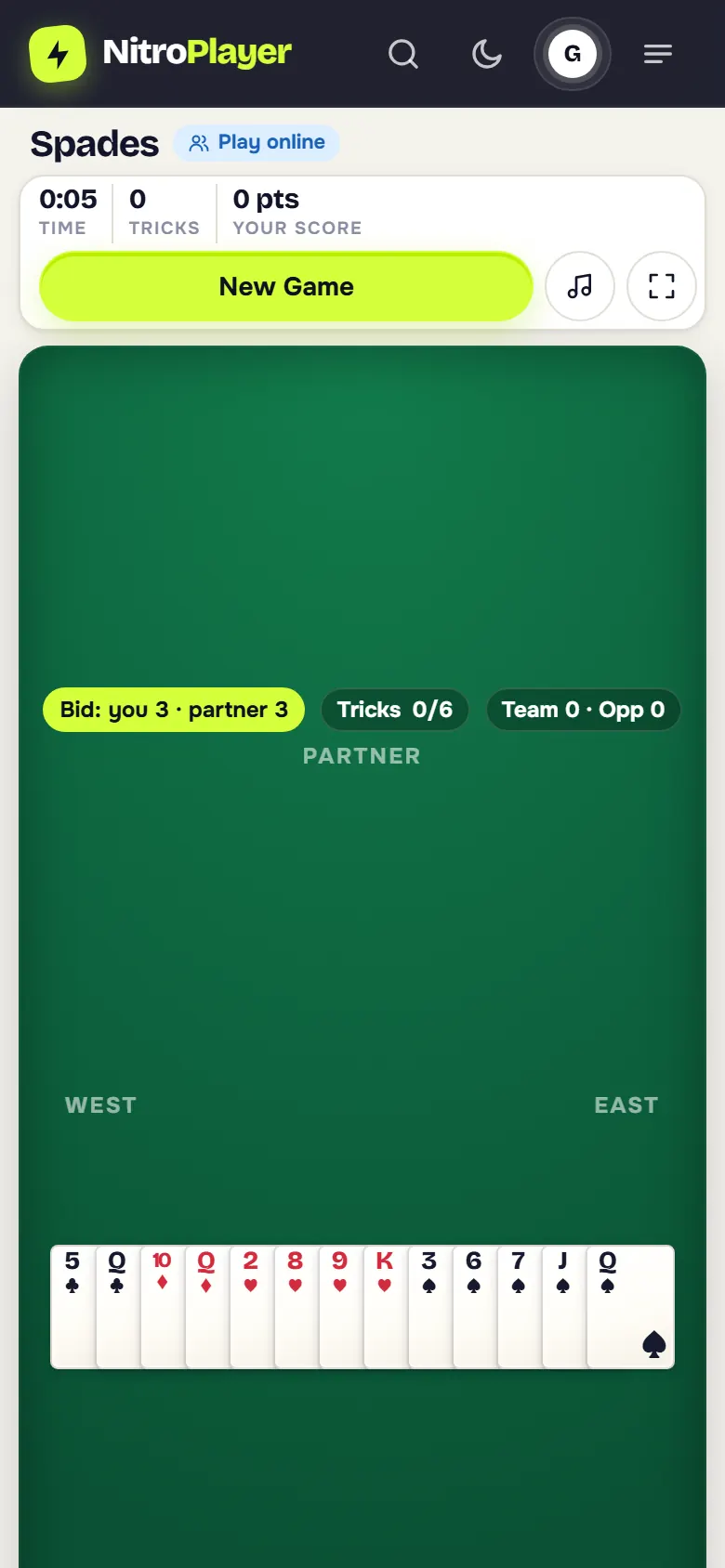
Spades on your phone
On a phone, bidding is a row of buttons from Nil to 13, with the suggested bid highlighted, and play is one tap per card from the fan at the bottom of the screen. The info bar tracks both team scores, bids, tricks and bags. Turn the phone sideways for a wider hand. Solo games save after every card, scores and bags included, so a refresh never costs you a contract. For one-tap access, install the NitroPlayer app from your browser.