How to play backgammon
The board
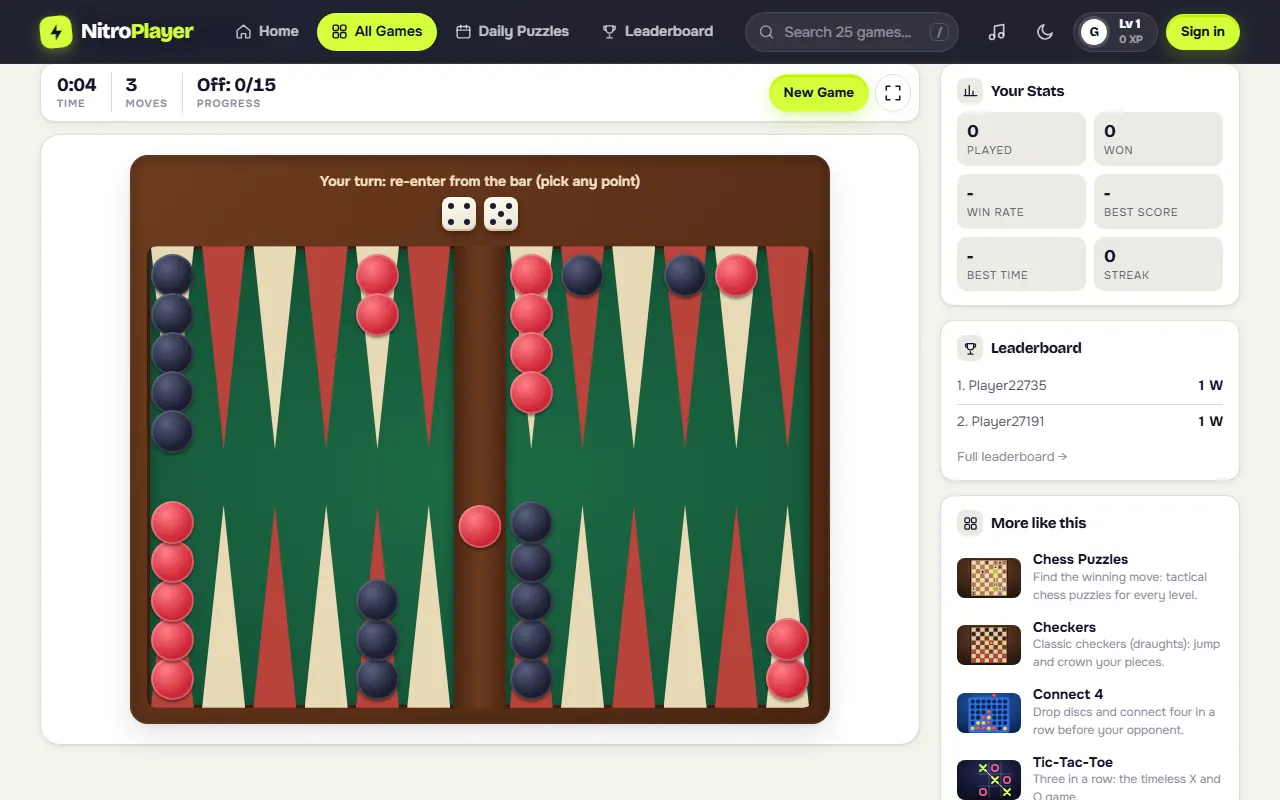
The board has 24 narrow triangles called points, in four quarters of six. The last quarter on your route is your home board, and the strip in the middle is the bar. You always play the red checkers. Your opponent's dark checkers travel the opposite way, so the two armies meet head on.
A turn, step by step
- Opening roll. Each side rolls one die. The higher die starts and plays both numbers as its first move, and a tie simply rolls again.
- Roll. After that, two dice are rolled for you at the start of each turn.
- Move. Each die moves one checker that many points. With a 5 and a 2 you can move two different checkers, or the same checker twice.
- Doubles. Matching dice are played four times, so double 4 means four moves of 4.
- Land legally. You may land on an empty point, on your own checkers, or on a point with a single opposing checker.
- Go home and bear off. When all 15 checkers are in your home board, start removing them. The first player with every checker off wins.
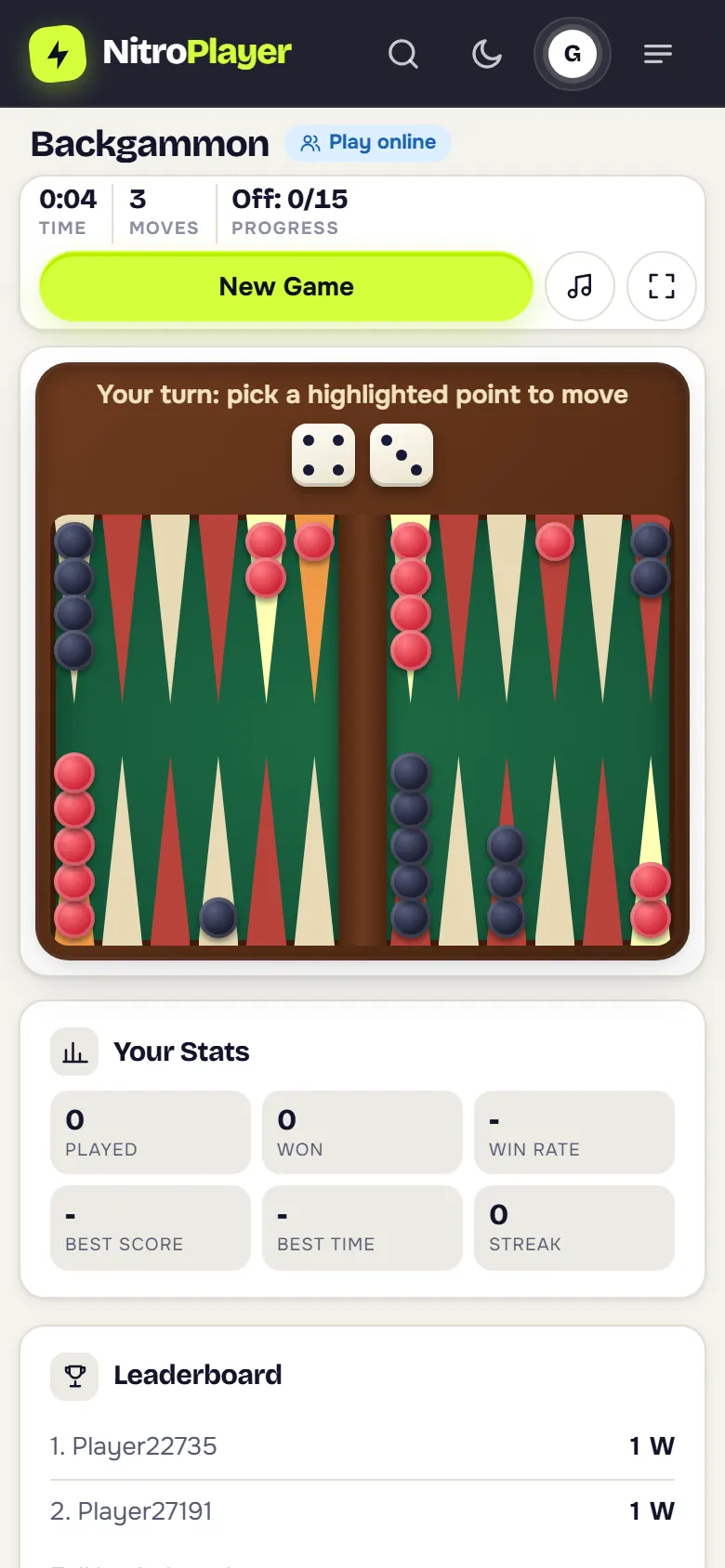
Against the computer, tap a lit point to pick up a checker. The points it can reach light up with a small badge showing the die that gets it there, so with a 6 and a 1 you choose exactly which number this checker uses. Used dice are grayed out. Online, tap a checker first and then one of the highlighted destinations.
Backgammon rules
Blots, hits and the bar
A single checker alone on a point is a blot. If your opponent lands on it, it is hit and goes to the bar. A checker on the bar must come back in through your opponent's home board before you may move anything else, and if the dice only point to blocked spots, your turn is lost.
Points and primes
Two or more checkers on a point make it yours: your opponent cannot land there. Six blocked points in a row form a prime, a wall nothing can get past.
Bearing off
Once every checker is home, a die removes a checker from the matching point: a 6 from the 6-point, a 3 from the 3-point. A higher number can be used for a lower point only when no checker sits farther back.
House rules in this version
- If no legal move exists, a message tells you and the turn passes automatically.
- Every game follows the full tournament rule: you must use both dice whenever possible, and if only one can be played, it must be the larger one when that works. Only legal moves light up.
- When your checkers are all home, a Bear off button appears so you can take a checker off without aiming at the edge of the board.
- There is no doubling cube. Every game is a single game played to the end.
Gammons and backgammons
Online games also report how big the win was:
| Result | Condition |
|---|---|
| Single win | The loser had borne off at least one checker |
| Gammon | The loser had not borne off any checkers |
| Backgammon | A gammon where the loser still has a checker on the bar or in the winner's home board |
Online, the turn line also shows both pip counts, the total distance each side still has to travel.
Backgammon strategy for beginners
Know your opening rolls
Some first rolls have a clear best play: 3-1 makes your 5-point, 4-2 makes your 4-point, and 6-1 makes your bar point (the 7-point). Each builds a block right in front of your opponent's back checkers.
Points beat blots
Two checkers together are safe; one alone is a target. When you must leave a blot, place it where fewer dice combinations can reach it. A checker 7 or more points from the nearest enemy is much safer than one exactly 6 away.
Count the race
If your pip count is clearly lower, break contact and run home. If you are behind, keep checkers back and wait for a shot.
Hit when it is cheap
Sending an enemy checker to the bar costs them all the distance it traveled. It is usually right, unless hitting leaves several of your own blots exposed to a return shot.
Build a prime, free your back checkers
Four or five blocked points in a row trap whatever is behind them. Meanwhile, do not forget your own two rearmost checkers: they have the longest trip and can get stuck behind your opponent's wall.
Bear off carefully
If contact remains while you bear off, clear your highest points first and avoid leaving single checkers behind.
Play backgammon online with friends
- Play online starts a one-on-one game with whoever is available.
- Play with a friend gives you a private link; the game begins when your friend opens it.
- Play vs computer is a relaxed solo game with three levels: Easy for learning the moves, Medium for a fair contest and Hard for a serious opponent. The level you pick is remembered for next time.
In online games the dice are rolled on the server, so neither player can influence them, and the board is always drawn from your side with your checkers in red. You get emoji reactions, quick chat messages and a rematch button. Every win counts on the backgammon leaderboard.
History of backgammon
Backgammon is a member of the tables family, one of the oldest groups of board games. Dice race games were played in ancient Mesopotamia and Persia, the Romans had a close relative called Tabula, and versions of tables spread across medieval Europe. The name backgammon is recorded in England in the 17th century. In the 1920s American players added the doubling cube, now standard in match play; our version keeps the classic game without it.
Backgammon on your phone
The 24 points need width, so turn your phone sideways or use the Full screen button for the roomiest board. Lit points show where you can move, which saves careful aiming with a thumb. Games against the computer are saved after every move, so a call or a closed tab never costs you the game. To open it in one tap, install NitroPlayer on your home screen.