How to play Sudoku online
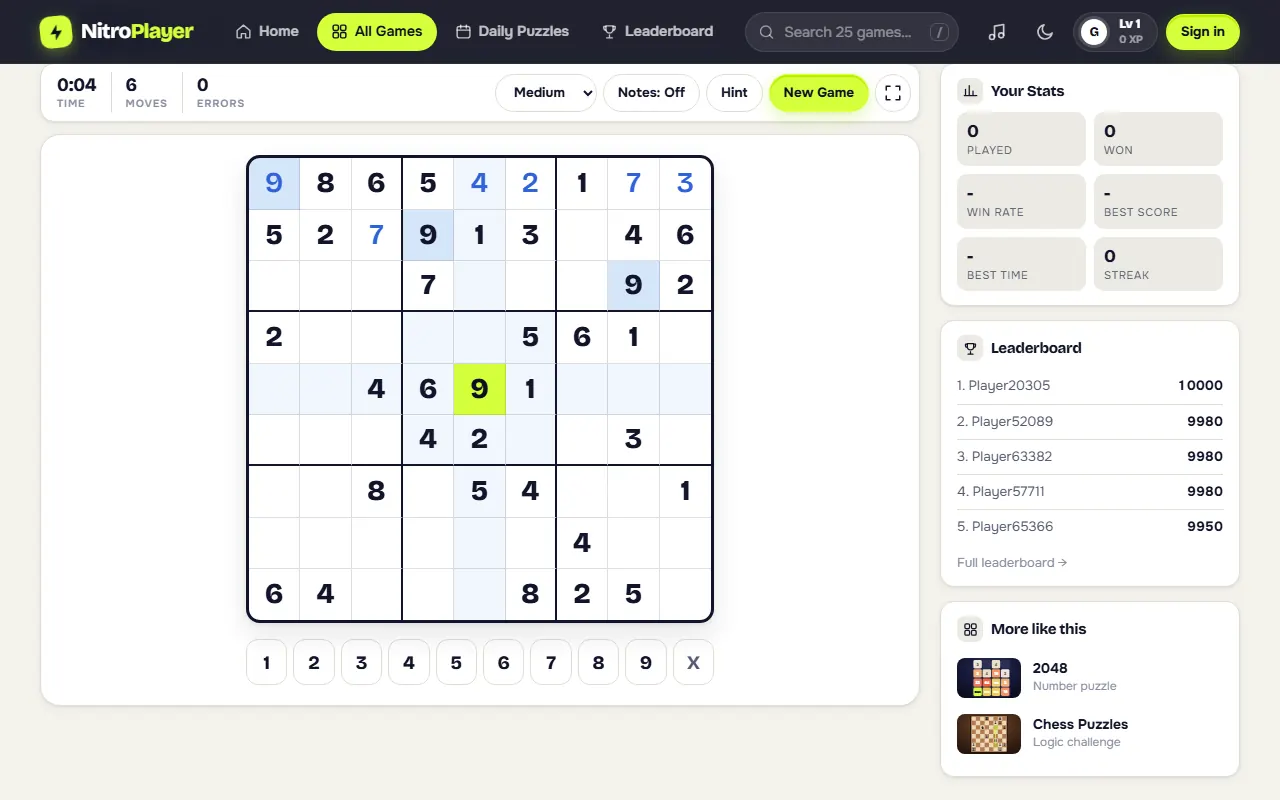
The board is a 9x9 grid divided into nine 3x3 boxes. Some cells start filled in. These givens are locked; everything else is yours to fill.
- Select a cell with a click or a tap. Its row, column and box light up, and every copy of the same digit is highlighted, so you can scan the board quickly.
- Enter a digit with the keyboard (1 to 9) or the big number pad, which sits to the right of the grid on a computer and under it on a phone. Each key shows how many of that digit are still missing, and a key fades once all nine are placed. Erase, Backspace, Delete or 0 clears a cell.
- Switch to notes with the N key or the Notes button to pencil in small candidate digits. When you place a real number, that digit is removed automatically from the notes in the same row, column and box.
- Made a mistake? Press Undo (or Ctrl+Z, or the U key) to step back as many moves as you need.
- Complete the grid. The moment the last cell is correct, the timer stops and your result is saved.
Sudoku levels: Easy, Medium, Hard and Expert
The only rule: each row, each column and each 3x3 box contains the digits 1 to 9 with no repeats. No arithmetic is needed, just careful elimination.
The level decides how many cells are blank at the start. The generator removes cells one by one and keeps a blank only if the grid still has a single solution:
| Level | Blank cells (target) | Suits |
|---|---|---|
| Easy | 36 | Beginners and quick coffee breaks |
| Medium | 46 | Regular solvers (the default) |
| Hard | 52 | Players comfortable with pairs and pointing |
| Expert | up to 58 | Long sessions that need notes throughout |
The game remembers your level. A digit that clashes with another in its row, column or box is marked, and the Errors counter rises whenever a number does not match the solution. Errors never end the game; they simply show where a deduction went wrong.
Scoring, hints and the leaderboard
The toolbar shows your time, moves and errors. A finished grid scores 10,000 points minus 10 for every second on the clock, so a five minute solve is worth 7,000.
The Hint button fills one correct cell: the selected one if it is empty or wrong, otherwise the easiest open cell. Each hint takes 500 points off the final score and the hinted cell gets its own color. The Sudoku leaderboard has a separate board for each difficulty, Easy, Medium, Hard and Expert, plus the daily puzzle, each ranked by best solving time, so you only race players on the same level.
Sudoku strategy: from singles to X-Wing
Strong solvers never guess. They look for the next move that is certain. These techniques, roughly in order of difficulty, cover nearly every grid you will meet here:
- Start where it is crowded. Rows, columns and boxes with the most digits have the fewest options left.
- Cross-hatching. Choose a digit and a box, then trace that digit's rows and columns through the box. Often a single cell survives.
- Naked singles. If eight digits already see a cell through its row, column and box, the ninth is the answer.
- Hidden singles. A digit with only one possible home in a unit goes there, even if the cell has other candidates.
- Naked pairs. Two cells in a unit that both hold only, say, 3 and 7 claim those digits. Erase 3 and 7 from the rest of that unit.
- Pointing. When a digit's candidates inside a box all sit on one line, remove that digit from the same line outside the box.
- Box line reduction. The mirror case: if a row's only spots for a digit are inside one box, clear it from the rest of that box.
- X-Wing. A digit that appears exactly twice in each of two rows, in the same two columns, can be removed from those columns elsewhere.
- Update notes after every placement. Each new digit removes candidates from three units; cleaning up right away exposes the next single.
A hint costs as much as 50 seconds of solving, so one more full scan is usually the better deal.
Daily Sudoku
One new daily Sudoku appears every day, and every player gets the same Easy grid, so the ranking by time is fair. Open it from the daily puzzles page, where it sits next to the daily Solitaire, Wordle style puzzle, Mahjong, FreeCell, Word Search and Minesweeper. Finishing any daily puzzle keeps your streak alive.
Sudoku duel rules
A duel turns a quiet solo puzzle into a race. Play online with whoever is available, or send a private link to a friend.
- Identical grid. Both players get the same medium puzzle with about 45 blanks.
- Live progress. A bar shows how many correct cells your opponent has, but not which ones.
- Accuracy matters. Hints are off, and a wrong digit locks your board for 10 seconds.
- Winning. The first complete, correct grid wins. After 12 minutes the player with more correct cells wins, and fewer mistakes breaks a tie.
Sudoku on a phone or tablet
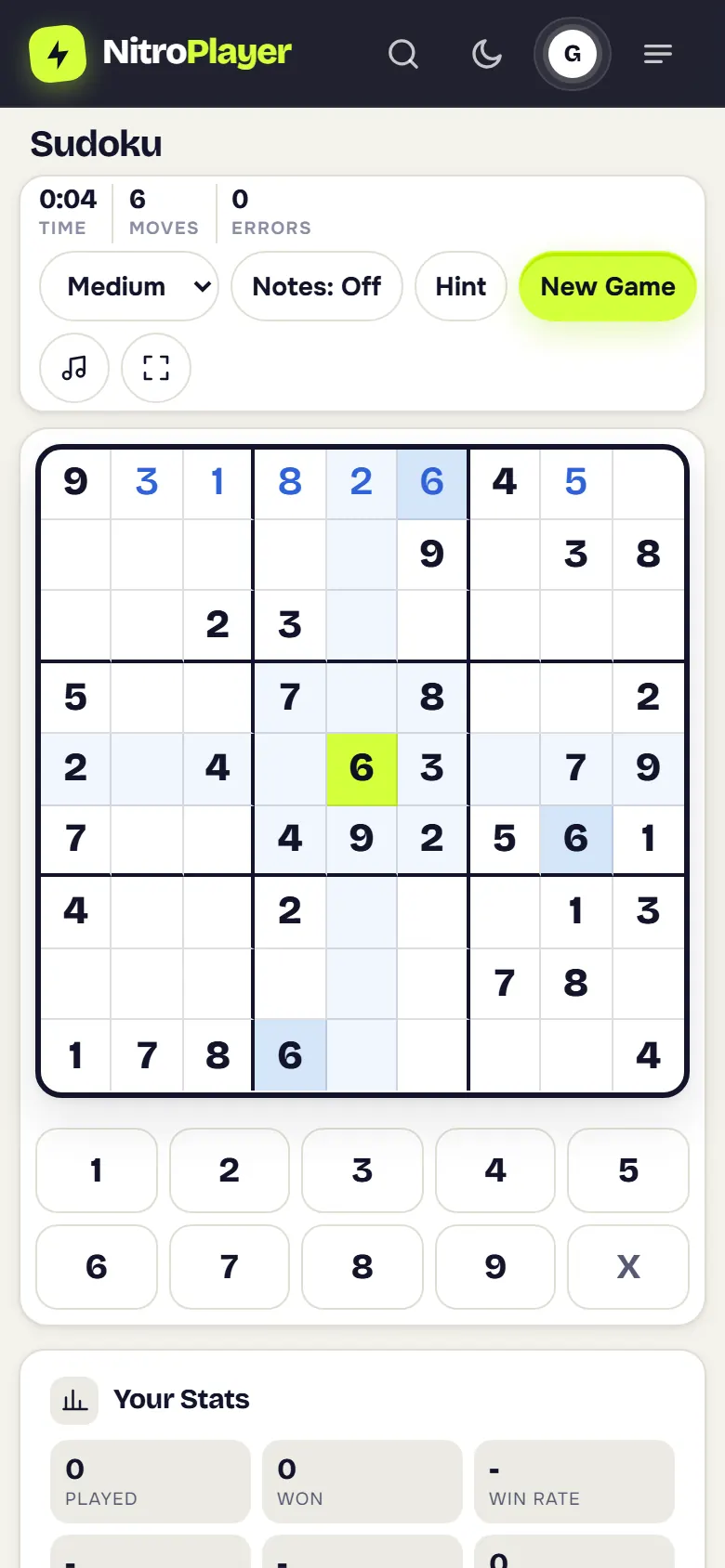
On a touch screen the number pad under the grid does all the work, so you can solve with one thumb while the board stays in view. Undo, Erase, Notes and Hint sit right next to the digits, and Notes mode is one tap away, which matters on Hard and Expert grids where pencil marks pile up. To keep Sudoku a tap from your home screen, add NitroPlayer as an app. Since the grid, notes and timer are saved on your device, a puzzle started on the bus is still there at lunch.
Where Sudoku comes from
The puzzle appeared in 1979 in an American magazine under the name Number Place and is usually credited to designer Howard Garns. The Japanese publisher Nikoli picked it up in the 1980s and named it Sudoku, short for a phrase meaning the digits must stay single. Daily newspaper printings in the United Kingdom in 2004 and 2005 turned it into a worldwide habit. If you enjoy the deduction, classic Minesweeper uses the same kind of certain-or-nothing logic with a time pressure twist.