Memory Game Tips: How to Win Memory Match in Fewer Moves
To win a memory game in fewer moves, remember every card you see and always flip a new card first: if you already know where its twin is, flip the twin for a sure match, and if not, flip another new card. In our test on 200,000 shuffled 16-card games, this averaged 12.4 moves, against 19.6 moves when you flip a known card first and 64 moves with random flips.
Key points
- New card first, always. It averages 12.4 moves on a 16-card board in our test, and never took more than 15.
- Flipping a card you already know first wastes half the move: it averaged 19.6 moves.
- Flipping at random with no memory averaged 64 moves. Memory is the whole game.
- A perfect 8-move game is about a 1 in 2 million shot, so aim for 12 or fewer.
- Score on NitroPlayer: 1,000 minus 20 per move and 2 per second. One wasted move costs as much as 10 seconds.
Play Memory Match freeNo download, no sign-up. Play solo, online or with a friend.
We tested three ways to play on 200,000 boards
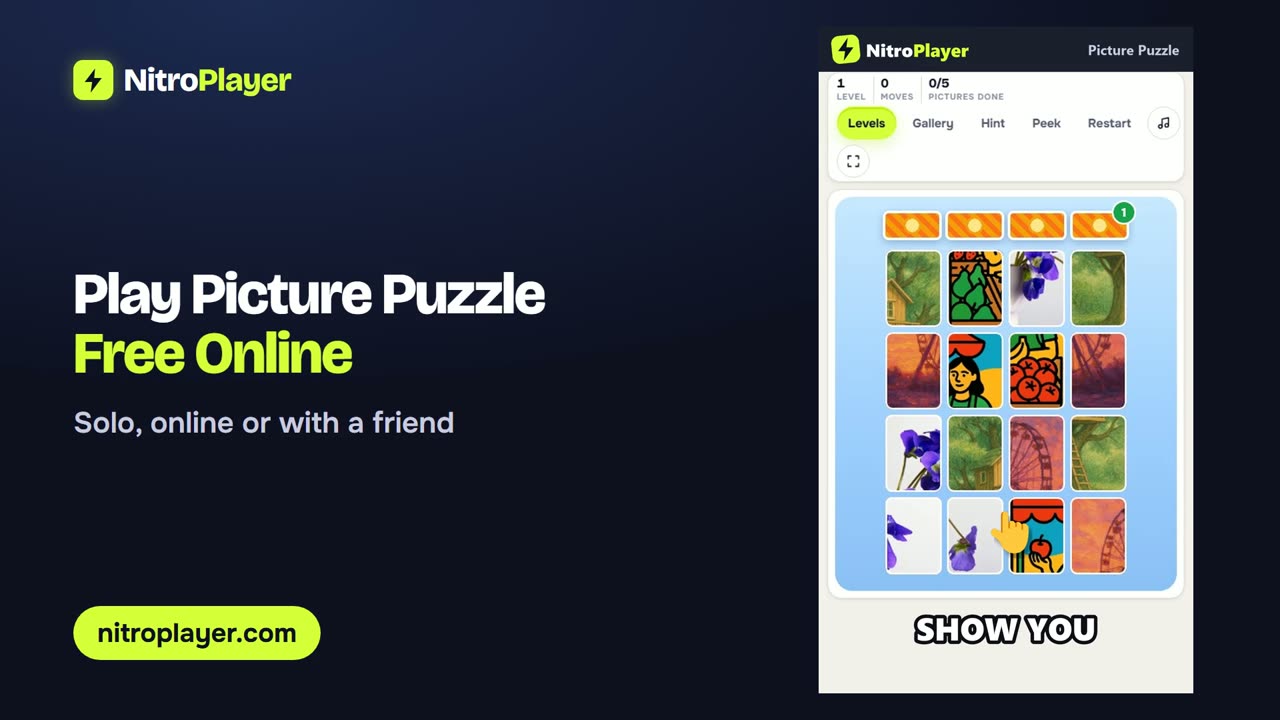
Our Memory Match game uses 16 cards in a 4 by 4 grid: eight animals, two of each. A move is two flips, matched or not. We shuffled 200,000 boards and played each one three ways with a simple computer test.
| How you play | Average moves | Typical game | Worst game |
|---|---|---|---|
| Remember everything, flip a new card first | 12.4 | 12 | 15 |
| Remember everything, flip a known card first | 19.6 | 20 | 22 |
| Flip at random, remember nothing | 64.0 | 60 | more than 200 |
In both memory strategies, any pair you have already seen both halves of gets matched right away. The only difference is the order of the flips when no pair is known. That one habit saves about 7 moves a game, which on NitroPlayer is about 140 points.
Why you should flip a new card first
Think about what each flip tells you.
- Known card first: you learn nothing from the first flip, because you already knew what it was. Your second flip is a new card, and the chance it is the twin of that one known card is small. Most of the time you spend a move to see a single new card.
- New card first: the first flip is new information. If its twin is already in your memory, the second flip is a sure match. If not, your second flip is also a new card, so you see two new cards in one move.
That is the whole memory match strategy: never spend your first flip on a card you have already seen. In our test, 55% of games played this way finished in 12 moves or fewer.
Worked example: the dog and the cat
This is the game from the video.
- Move 1: flip the top-left card, a dog. Flip a card in the second row, a cat. No match, and both turn back after a moment. Lock them in: dog top left, cat in the second row.
- Move 2: flip a new card first. It is a cat. You already know where the other cat is, so flip it. Match.
- Move 3: again, a new card first. It is the dog. Flip the top-left card. Match.
Two pairs in three moves. The video board was set up so that both new cards hit an animal already seen. In a real game the new card is often an animal you have not met yet. Then follow the rule: flip another new card, and remember both.
How to remember where the cards are
The strategy only works if you remember what you saw. Cards that do not match stay up for less than a second in solo play, so you need a quick system.
- Name it and place it. Say "fox, top right" in your head the moment a card turns. Words stick better than pictures alone.
- Explore in order. When you flip new cards, go row by row. A fixed path makes positions easier to recall.
- Use corners and edges. The four corners are the easiest spots to remember. Tie other cards to the nearest corner.
- Think in quarters. Treat the 4 by 4 board as four blocks of four. Four small areas are easier than 16 loose spots.
- Clear known pairs at once. As soon as you have seen both halves of a pair, match it before you forget.
What is a good score in Memory Match?
On NitroPlayer your score starts at 1,000 and loses 20 points per move and 2 points per second. Some examples:
| Moves | Time | Score |
|---|---|---|
| 8 (perfect) | 20 seconds | 800 |
| 12 | 45 seconds | 670 |
| 15 | 60 seconds | 580 |
| 20 | 60 seconds | 480 |
A perfect 8-move game needs every move to be a match, including the first, before you have seen anything. The odds of that are about 1 in 2 million. So a realistic goal is 12 moves or fewer. Since one extra move costs as much as 10 seconds, it pays to take a breath and recall a position rather than flip fast and guess.
Memory game tips for two players
You can also play online, taking turns with whoever is available, or send a private link to a friend. Find a pair and you score a point and go again; miss and the turn passes. The player with more pairs wins, and 4 to 4 is a draw.
Two extra tips for this mode. First, watch your opponent's turn: their missed cards are shown to both players, so every miss they make is free information for you. Second, be careful with the new-card-first rule late in the game. If your first flip is a new card with no known twin, your second flip may reveal a pair your opponent can then take. It is free, with no download and no sign-up.
Frequently asked questions
What is the best strategy for a memory game?
Remember every card you see and always flip a new card first. If its twin is known, flip the twin; if not, flip another new card. In our test on 200,000 shuffled 16-card games this averaged 12.4 moves.
What is the fewest moves to win Memory Match?
Eight, one per pair. It needs every move to be a match from the start, which happens in roughly 1 in 2 million games. With good play, 12 moves or fewer is a strong result.
How many cards are in Memory Match on NitroPlayer?
Sixteen cards in a 4 by 4 grid: eight animal pairs, a dog, a cat, a fox, a bear, a panda, a koala, a lion and a frog. The cards are shuffled for every new game.
Is a memory game just luck?
Only a little. Luck decides which cards you see first, but memory and flip order decide the rest. In our test, flipping at random averaged 64 moves, while remembering cards and flipping a new card first averaged 12.4.
Video transcript
Want to win Memory Match in fewer moves? Try this.
Don't just flip at random. Remember every card you see.
This one's a dog, and that one's a cat. Lock them in.
Now always flip a new card first. A cat! You already know where its twin is.
Again: a new card, and it's the dog. Easy match!
Fewer moves means a better score.
Now you try! And on NitroPlayer, you can play with your friends. Games are so much more fun together.
Play free at NitroPlayer dot com.