How to play Blackjack
Card values
| Card | Value |
|---|---|
| 2 to 10 | Face value |
| Jack, Queen, King | 10 |
| Ace | 11, or 1 if 11 would take the hand over 21 |
A hand where an Ace still counts as 11 is soft (Ace and 6 is soft 17). Every other hand is hard.
A round, step by step
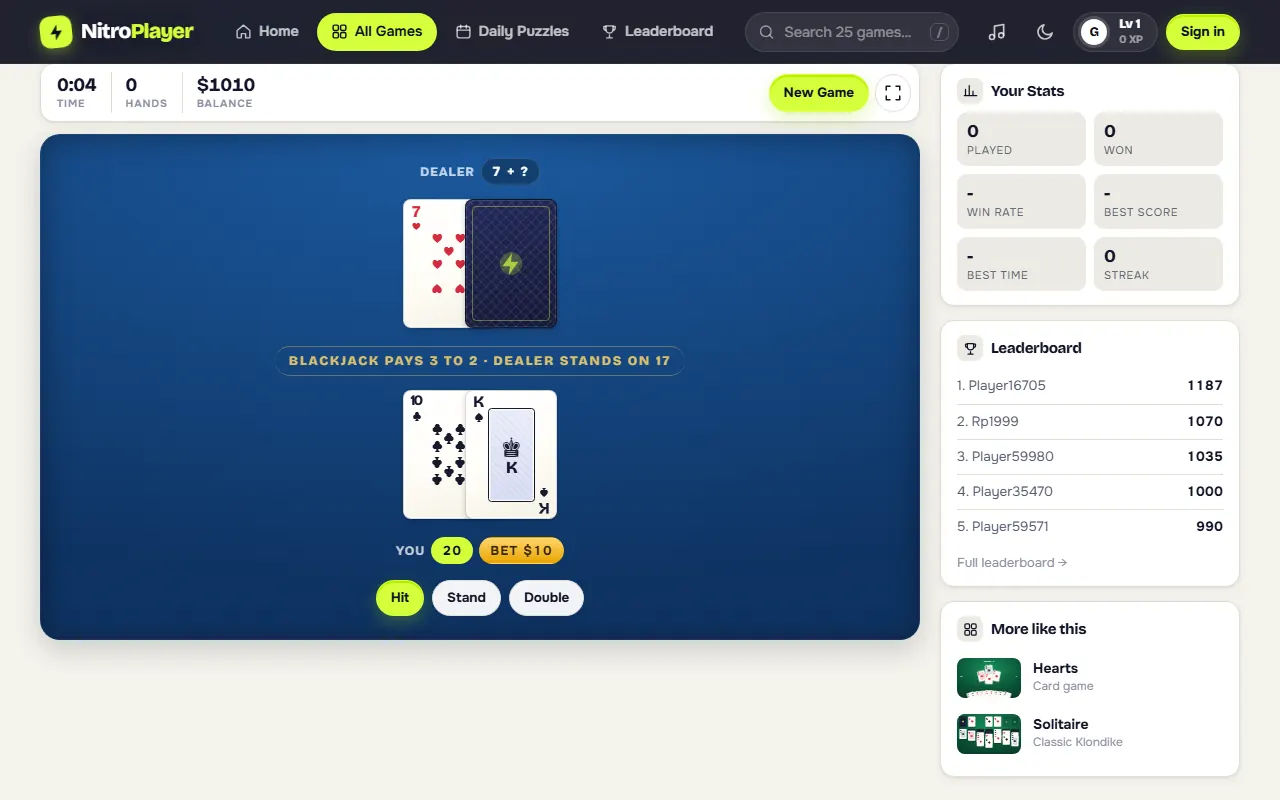
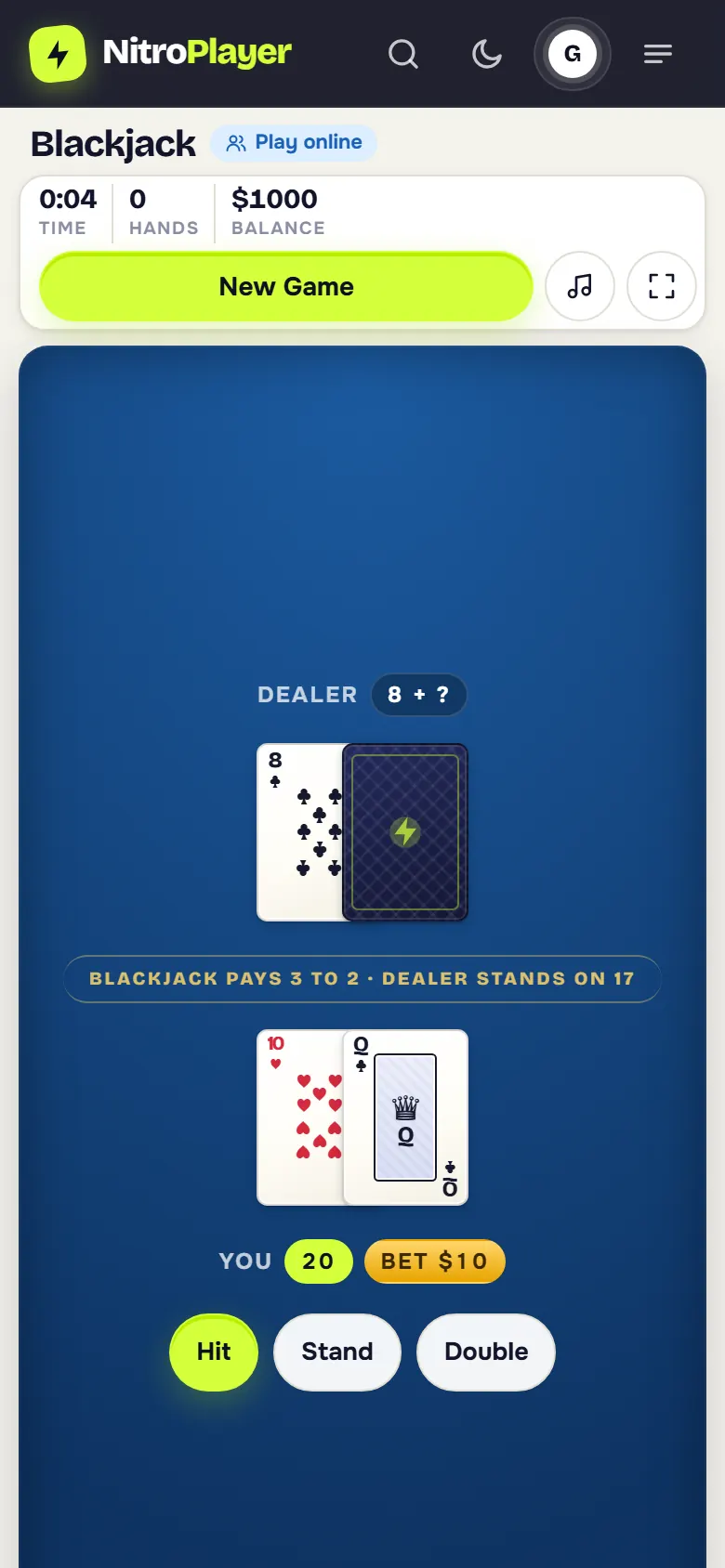
- You and the dealer each get two cards. One dealer card stays face down.
- An Ace plus any 10-value card on your first two cards is a blackjack, the strongest hand in the game.
- Otherwise you choose:
- Hit: take another card, as many times as you like.
- Stand: keep your total and end your turn.
- Double: on your first two cards only, double the bet, take exactly one card and stand.
- Split: with two cards of the same value, add a second bet and play them as two separate hands.
- Go over 21 and you bust, losing the hand at once.
- When everyone has finished, the dealer turns over the hidden card and draws until reaching 17 or more. If every player hand has already bust, the dealer does not need to draw.
- If the dealer busts, every hand still standing wins. Otherwise the higher total wins, and equal totals are a push.
Blackjack table rules
- Six-deck shoe. Cards are dealt from a six-deck shoe that stays in play between hands and is reshuffled once about 75% of it has been used.
- The dealer peeks. With an Ace or a 10-value card showing, the dealer checks for blackjack before anyone acts. A dealer blackjack ends the hand at once.
- The dealer stands on all 17s, soft 17 included, and hits 16 or less. The dealer never makes choices.
- Blackjack pays 3 to 2. A win pays even money, and a push returns your bet.
- Double on any first two cards, also after a split (except on split Aces).
- Split any two cards of the same value, up to four hands. Split Aces receive one card each, and 21 on a split hand counts as 21, not blackjack. Insurance is not offered.
Solo games and online tables use the same rules:
| Solo game | Online table | |
|---|---|---|
| Players | You against the dealer | Up to 4, each with their own hands |
| Starting chips | 1,000 | 1,000 per seat |
| Bets | Build your bet with 5, 10, 25 and 100 chips | Choose 10, 25, 50 or 100 for the next hand |
| Out of chips | Tap for a free stack of 1,000 | A fresh stack of 1,000 at the next hand |
Blackjack basic strategy tips
Basic strategy is the mathematically best play for every total against every dealer up card. Here is a simplified version for these rules:
Hard hands
- Hard 17 or more: always stand.
- Hard 13 to 16: stand against a dealer 2 to 6, hit against 7 or higher.
- Hard 12: stand against 4, 5 or 6; hit against everything else.
- 11 or less: always take a card, since you cannot bust.
When to double
- 11 against any dealer card except an Ace.
- 10 against a dealer 2 to 9.
- 9 against a dealer 3 to 6.
Soft hands
- Soft 17 or less: always hit. The Ace protects you from busting on the next card.
- Soft 18: stand against 2, 7 or 8; hit against 9, 10 or Ace.
- Soft 19 and 20: stand.
When to split
- Always split Aces and 8s. Two Aces are a weak 12 together but a great start apart, and a pair of 8s is the worst total in the game, hard 16.
- Never split 5s or 10-value cards. A 10 is a strong double and 20 is already a winning hand.
- 2s, 3s and 7s split against a dealer 2 to 7; 6s against 2 to 6; 9s against 2 to 9, except 7.
The dealer's up card is half of every decision. A 4, 5 or 6 showing means the dealer busts often, so let them take the risk. A 7 or higher means you usually need a real total of your own. No strategy wins every hand; basic strategy just makes the best choice on average.
Play Blackjack with friends at one table
Unlike poker, Blackjack players are not playing against each other: everyone at the table faces the same dealer, so friends can cheer each other on.
- Play with a friend: open a private table and share the link with up to three people. The host presses Start now when the group is seated.
- Play online: sit down at a public table with whoever is available.
- Play vs computer: a solo game against the dealer.
Players act in seat order with a turn timer, and the dealer's hole card stays on the server until the dealer's turn, so nobody can peek. Split hands are played one after the other, with the hand in play highlighted. Pick your next bet between hands, watch everyone's chip stack, and use the chat for a quick emoji when a friend doubles on 11 and hits 21. A hand that ends level counts as a push, not a loss. Track how your results compare on the Blackjack leaderboard.
History of Blackjack
Blackjack comes from a family of European card games built around a total of 21. The French game vingt-et-un ("twenty-one") was popular in the 1700s and traveled to North America, where it was known simply as twenty-one. The name blackjack is usually linked to an old bonus for a hand holding the Ace of Spades with a black Jack. In the twentieth century, mathematicians analyzed the game in detail, and their work produced the basic strategy charts players study today.
Blackjack on your phone
Blackjack suits a small screen: one row of dealer cards, one row of yours, and big Hit, Stand, Double and Split buttons under your thumb. A round takes seconds, so it fits a short wait in line. It works in portrait, with no need to turn the phone. Install NitroPlayer as an app to open the table straight from your home screen.
More card games
For a game where you play the other players instead of the house, sit down at Texas Hold'em poker with virtual chips. For something calmer, deal a hand of classic Klondike Solitaire.